Monday, 11 April 2022

Living on the ceiling

Avid followers of this blog may have been dismayed to find I haven’t published a new post here for a few months. (Well, I can hope that someone cares that much!) This sounds like a “my-dog-ate-my-homework” kind of excuse but here goes... At the end of last October, part of the ceiling of my attic collapsed. And so began a lengthy process of finding a builder and then waiting a few months for a succession of builders, plasterers, electricians, painters and carpet-fitters to come along, make repairs and renovations and leave me with a newly-restored attic/guest bedroom.

Of course, you can’t repair an attic while it’s full so it also necessitated me moving furniture, clothes, books, bric-a-brac and all the kinds of things you might expect to find in an attic ( - just about anything that you don’t want to keep in any other room and can’t bear to throw away - ) into various other parts of the house, including my office. If you want to stop a writer (or any other type of creative) from working I can recommend arranging for their attic ceiling to collapse as a perfect way to scupper all creative output for several months.

I have managed to write no more than one song and a handful of album reviews since the ceiling first began to fall down. Work on my novel, several short stories, ideas for articles, recordings for my next album and even blog posts has been suspended while, week after week, tradesmen have been running up and down my stairs at unexpected times of the day, turning my electricity on and off as the whim takes them, playing Fleetwood Mac and the Bee Gees at high volume and generating a cloud of dust that covered every surface of the house, only to be renewed the next day after Sisyphean efforts at hoovering and dusting.     

Now that the renovations are complete and I can gradually start moving things back to their rightful places (which, in some cases, is the charity shop or the recycling centre) I feel able to concentrate once more. So you can expect more regular blog posts while I play catch-up on the things I’ve been meaning to share with you. But, first, would you mind giving me a hand with some of these boxes?...

Sunday, 23 January 2022

Ghost owls and sleeping spirals - a selection of albums from 2021

While last year provided extreme challenges for live music it also saw an outpouring of outstanding recordings. Many artists switched their energies into recording projects as tours and festivals were cancelled or postponed. So, here’s a selection of 2021 releases that are worth discovering - or revisiting...

Wardruna's stirring fifth album, Kvitravn, sounded like it could have been the dramatic soundtrack to a Viking movie - and with good reason; the Norwegian band's founder member, singer and composer Einar Selvik contributed music to the TV series Vikings.

Wardruna use rather esoteric instruments including the taglharpa, kravik-lyr and goat horn, along with occasional sound effects like thunder and wolves howling, in this collection of songs about white ravens, stags and spirit-weavers. This might all sound contrived but Wardruna perform with such conviction the effect is undeniably compelling.

Selvik has a background in black metal - he was previously the drummer in Gorgoroth - and insistent drums and potent vocals feature here, evidence that dark, pagan folk might, after all, be the more thoughtful cousin of satanic black metal.

Wardruna describe the album as "a visual soundscape" and, on tracks like 'Fylgjutal' and 'Vindavlarljod', it's easy to imagine raiders setting sail across the North Sea in longships. If you're facing a job interview or some other challenge Kvitravn could be just the thing to put you in an invincible frame of mind.

Fans of Wardruna will be pleased to hear the 2016 album by Ivar Bjørnson & Einar Selvik Skuggsjá has just been reissued – and Warduna are embarking on a mammoth world tour starting in March.

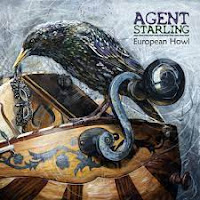
In a very different style, another band who enjoy using esoteric instruments are Agent Starling, who have made the hurdy-gurdy cool (again.) I wrote about this duo’s debut album European Howl (not to mention their seasonal Northern Lights Trilogy EP) in a previous blog post, so I won’t repeat myself. However, I would count European Howl among the most original albums of 2021 and I am thrilled to learn that Agent Starling are next month releasing a follow-up full-length album - Constellation of Birds. I'll be reviewing that soon here on the blog. 


2021 also saw the release of Ghost Owl, which came about after wildlife conservationist and filmmaker/photographer Simon Hurwitz asked Brooks Williams to compose some music to accompany some short films. Williams (born in Georgia, USA but now resident in Cambridge, UK) is a long-serving purveyor of rootsy, full-blooded acoustic guitar. With touring on hold, he teamed up with violinist Aaron Catlow and the duo found themselves with an album’s worth of owl-inspired tunes.

These ten instrumentals evoke images of the majestic creature with the heart-shaped face. The marriage of guitar and violin recalls the style of Martin Carthy and Dave Swarbrick and, occasionally, of Django Reinhardt and Stéphane Grappelli.

The title track and ‘Rene’s Garden’ are sinuous and atmospheric, the ethereal violin on ‘Tipper’s Field’ is suitably owlish while ‘First Dusk’ is an old-time waltz. With the bonus of Hurwitz’s wonderful owl photography illustrating the CD, Ghost Owl is a delight.  

While Warduna’s Einar Selvik loves his taglharpa, Andy Aquarius prefers his harps to be of the Celtic variety. If you’re thinking Andy Aquarius can’t be his real name, you’d be right. Andy Ozbolt is a singer and multi-instrumentalist with German and Croatian roots, currently based in Berlin. His previous musical output has been accessible, dreamy pop, à la Tame Impala. But his 2021 album Chapel dispenses with synths and trippy drum patterns and features little more than his self-built Celtic harp and vocals.

The opening title track sets the tone with three minutes of solo harp before Aquarius’s vocal begins, soon joined by Enya-like backing vocals provided by Maja Presnell. Aquarius’s singing style reminds me of fellow German multi-instrumentalist Nils Kercher, and the overall effect is similar to Kercher’s earlier albums – gentle and meditative.

Although there are only six tracks most are over six minutes, allowing plenty of time for the listener to get lost in the unhurried flow of the music. At times, it could almost be the kind of new age music used as an accompaniment to yoga, but there is enough melodic and rhythmic interest to make Chapel more than mere background listening.    


One of the most surprising collaborations of 2021 was Sleeping Spirals which saw singer, accordionist and dancer Hannah James team up with French cellist Toby Kuhn. This is a exquisitely-produced album, both musically and in terms of the cover design – the CD is a thing of beauty. The combination of James’ voice and Kuhn’s often highly-experimental cello creates an atmosphere like a melancholic, brooding European folk tale, unnerving but compelling. 

Not many artists can boast twenty-three studio albums to their name but Welsh singer-songwriter Martyn Joseph achieved this last year with the release of 1960 – an album that takes its title from the year of his birth. The eleven tracks on 1960 form an extended reflection on reaching the age of sixty and all that entails. The opening song ‘Born Too Late’ laments the fact that Joseph missed out on being in Laurel Canyon in 1971, imagining what that would have been like, and considers “How long does it take for a man to know himself?” A pleasant surprise is that the track ‘House’ features, rather wonderfully, the singer-songwriter Janis Ian on piano and vocals.


Finally, if I had to name my favourite release of 2021 it would have to be global folk collective Mishra’s album Reclaim. Recorded ‘live-in-the-room’ in a farmhouse in Gloucestershire, Reclaim has immense freshness and positivity, a conscious attempt to reclaim the joy that music can give us when so much of our freedom has been restricted. Fusing British and American folk music with Indian classical music, Mishra have a deftness and a wonderful lightness of touch. The blending of Ford Collier’s whistles with Kate Griffin’s vocals and banjo and John Ball’s tabla accompaniment is unique and irresistible, as is Ball’s santoor playing on ‘This is the Sound.’ I am tempted to go off and live in a parallel universe where Reclaim’s bouncy, opening track ‘The Truth’ would be number one in the charts for a very long time. If this were the case, all would be well! But, if not, why not allow yourself to be transported in your imagination by trying some of the albums mentioned here.

Wednesday, 12 January 2022

The story is the telling - This is the Kit, plus by Nuala Honan (at The Castle & Falcon, Birmingham - 16 November 2021) and Alaw (at Bitterley Village Hall - 3 December 2021.)

In a year in which live music was touch and go, it was great to be able to attend two fantastic gigs towards the end of 2021. In November, I went to the Castle and Falcon in Birmingham to see This Is the Kit. It was a pleasure to see Kate Stables and her band play in a fairly intimate venue and the evening was made all the more special by the fact that I was joined by my nephew Tom (a Birmingham resident and, like his uncle, a fan of slightly quirky music.)

This Is the Kit were supported by Bristol-based Australian Nuala Honan and her band. I was so taken with Nuala’s infectious enthusiasm that, in the interval, I made a beeline to her merch table, had a pleasant chat with Nuala herself and bought her CD Doubt & Reckoning. The album is perfect music for driving and has been in my car’s CD player ever since. The only disappointment is that the album doesn’t include Nuala’s latest single I’m Alright which is charming and delightfully hooky. If you haven’t heard it yet, seek it out and play it on repeat a few times!

This is The Kit were very entertaining with Kate frequently spending time carefully tuning one instrument before realising she was supposed to be playing a different one, but she had a lovely rapport with the audience and the songs were as delicate and moving as they could be. Keep Going was a highlight, a song which could almost be an anthem for the pandemic age:

“The power in the naming / The story is the telling / Potential in the waiting / Movement is deciding / Forward is the doing / Keep going...”

And for anyone who has lost a loved one in recent times, the tense-shifting refrain of Keep Going took on a new power:

“This love has been ours / This love is ours / This love is still ours...”

Then, at the start of December, I headed over the hills (literally) to South Shropshire where, not far from Ludlow, the village of Bitterley nestles. Bitterley is one of a number of villages in Shropshire and Worcestershire - Alveley, Abberley, Dunley, Astley, Shrawley – that sound like adverbs. It’s tempting to suppose Bitterley got its name because, positioned on the western slopes of Titterstone Clee Hill, it must get bitterly cold in the winter.

Bitterley Village Hall was the venue for an Arts Alive event. Arts Alive promote professional arts and film events in partnership with local people, bringing high quality and affordable entertainment within easy travelling distance of people in Shropshire and Herefordshire. And so it was that I had the privilege of seeing a performance by Alaw, a superb folk trio from Wales. Guitarist Dylan Fowler and fiddler Oli Wilson-Dickson have been playing together for years and are now joined by the exceptional voice of Nia Lynn, who also provides a harmonium accompaniment. Oli is an immensely engaging front-man and the band took the audience on a journey through new and traditional Welsh folk tunes that demonstrate the Welsh tradition is unfairly neglected, compared with Scottish and Irish folk music.

So, from This is the Kit and Nuala Honan in heart of the big city to Alaw, playing over the hills and far away, live music is still out there to be had - and long may it continue. The story is the telling. Keep going.

Tuesday, 21 December 2021

Agent Starling's ‘Northern Lights Trilogy’ - a blast of seasonal cheer

One of the most innovative bands to appear in the past year has been Agent Starling, who have wasted no time in following up their debut album European Howl with a gorgeous seasonal EP offering - Northern Lights Trilogy.  

Agent Starling is an unusual duo, a pairing of hurdy-gurdy player Quentin Budworth with Louise Duffy-Howard (aka Lou Loudhailer.) Back in the 1980s, the latter was the bassist with one of my favourite indie bands, Red Guitars. When lockdown restrictions scuppered their usual musical projects, the two decided to create Agent Starling and record European Howl, a complex, immersive and at times disorienting listening experience. Its opening track ‘Helicopter Arms’ set the tone – pulsating, intriguing, the distinctive droning, buzzing but melodic sound of the hurdy-gurdy and whispered, spoken-word vocals (à la Traffic’s ‘Hole in My Shoe’.)

There were some traditional tunes on the album too – an agreeably ambient version of the Elizabethan carol ‘Drive the Cold Winter Away’ and a suitably inebriated-sounding ‘The Parting Glass’. By contrast, ‘Minor Surgery’ was a cyber-Morricone soundtrack with whipcrack noises and a splendid rumbling bassline. Throughout, the contributions of guest violinist/cellist Dexter Duffy-Howard added a lot to the overall texture.

So, I was delighted to hear that Agent Starling had decided to follow on from this engaging and original debut with the Northern Lights Trilogy EP or, as Lou describes it, “three new festive singles that add a bountiful sprinkling of bells, twinkles and festive spirit to our catchy hurdy-gurdy tunes, hypnotic drones, live bass grooves & strings.”

The three festive singles in question are ‘The Cordwainer’s Lament’, ‘Northern Lights’ and ‘Stockport Polka’. ‘The Cordwainer’s Lament’ sounds like an atmospheric musical walk down a snowy country lane. ‘Northern Lights’ is not – in case you were wondering - the 1978 hit by prog-rock band Renaissance but a totally different song, which mixes spoken-word with musical quotes from Prokofiev’s ‘Troika’ (if it was good enough for Greg Lake to borrow, it’s good enough for Agent Starling.) It’s a joyful, wintry offering. Amid a soundscape of sleigh bells and church bells, Lou sings “I know you yearn for calm, long for night, but my heart dances with the Northern Lights.” Finally, we have the exuberant ‘Stockport Polka’ (familiar as the tune that Jona Lewie used for his unlikely 1980 Christmas hit, ‘Stop the Cavalry’) but here performed with plenty of cymbals and a warbling sound on the hurdy-gurdy that sounds strangely like steel drums.

It’s all terrific fun and, for me, it’s the 2021 equivalent of the Cocteau Twins’ glorious 1993 Christmas EP Snow. If you’re short of Christmas cheer this year, you could do worse than to go to Bandcamp and get hold of the Northern Lights Trilogy.

But that’s not all! I’m reliably informed that Agent Starling are poised to release a second album in 2022. And, as if these weren't enough glad tidings, Red Guitars have reformed and, if the fates allow, will be touring in 2022. 

Monday, 29 November 2021

Nursing literary ambitions

My short story Weekend On Call has just been published. I’m delighted for two reasons. First, this is the second of my short stories to be published this year – my story Eastgate Clock was published in the March issue of Firewords magazine. Second, Weekend On Call was shortlisted for the Bridport Short Story Prize last year but didn’t make it through to the final selection. However, I then discovered it had been longlisted for the 2021 Bournemouth Writing Prize and was subsequently selected to be included in The Waves of Change, an anthology of short stories and poetry published by Fresher Publishing. I’m looking forward to reading all the other contributions in the collection.

Weekend On Call is an entirely fictional account of a weekend in the life of a mental health nurse manager. The combination of an alcohol problem, work-related stress and difficulties in his marriage lead to a crisis, as he struggles with his own mental health while being expected to oversee the management of mental health services over the weekend period. In the story, the on-call manager recalls something he was told back when he first trained as a mental health nurse:

           Back inside the house, you put the bleep and the on-call mobile on the coffee table and sit in an armchair, in the dark. You notice you can’t stop crying. When you did your nurse training all those years ago, you remember someone saying that to work in mental health you had to be ‘okay in yourself’. What did that mean? That you had to have good mental health in your own right? That you had to have a stable home life, a secure relationship, a happy marriage?

The Waves of Change is a remarkably apt title from my point of view. By a strange quirk the book's publication coincides with my decision not to renew my registration as a mental health nurse. I retired from the NHS in 2016 (but maintained my professional registration as I then began a second career as a senior lecturer in mental health nursing.) When my late wife became terminally ill I decided to retire from nurse education, ultimately becoming her full-time carer. Waves of Change indeed – retirement followed by widowerhood. But it is only now, as my professional registration comes up for renewal, that I am finally, officially un-becoming a registered nurse. I began my nurse training in 1983 so there hasn’t been a time in the past 38 years when I haven’t considered myself involved in mental health nursing. 

Relinquishing my nurse registration could be seen as another major life event and another loss. In one way I do feel like I’m surrendering a major part of who I am, but I’m considering it an opportunity to become something else. Now, having retired twice, I feel it’s time to let go of nursing and to focus more on my other lifelong interests – writing and music. That’s why it’s so good to have some of my fiction published this year. And so I begin my third career – this time as a full-time writer and musician. It sounds, somehow, so much more interesting than ‘retired mental health nurse’.   

The Waves of Change is published by Fresher Publishing and is available from all good bookstores.

This blog post is published simultaneously on my other blog: Tony Gillam on Creativity, Wellbeing and Mental Health 

Monday, 15 November 2021

From wistful synth-pop to masterful folk – Celebrating Worcester's Huntingdon Hall

One of my favourite live music venues is Worcester's Huntingdon Hall - a former 18th century Methodist chapel which continues to play host to an eclectic array of artists. Over the years, I’ve seen guitar wizards like Gordon Giltrap and Eduardo Nuebla, singer-songwriter Dean Friedman and prog-folk legends like Focus, The Strawbs, Magna Carta and Caravan. (Many of these shows are memorialised here on this very blog. Just use the ‘search’ button to revisit those.)

Now that live shows are getting going again I’ve been tempted back twice to Huntingdon Hall in the last two months. In October I saw – for the second time – eighties synth-pop balladeers China Crisis. I’d last seen them here almost exactly two years previously, and that earlier gig is poignantly memorable for being the last live concert that I ever went to with my late wife. We had been pleasantly surprised both by the charming familiarity and warmth of the music and the hilarious banter of singer Gary Daly, whose wit is more entertaining than many a stand-up comedian. Songs like Christian, Wishful Thinking and Black Man Ray have an enduring wistfulness.

When I saw China Crisis again last month the music was every bit as uplifting and the repartee every bit as funny. When some audience members began to call out to him between songs, Gary responded: ‘Ah, audience interaction! We like that because, to be honest, for a minute I thought you were all f***ing dead.’

Fewer laughs were to be had at last week’s Martin Simpson gig. I’d last seen Martin Simpson at Huntingdon Hall in 2010. This distinctive English folk singer, guitarist and songwriter is now 68 years old but he continues to dazzle with his mellifluent guitar playing and unaffecting singing. There were one or two self-deprecating jokes but this is an artist who takes his art seriously and whose audience respect him for that. A subtle, occasional use of delay on the vocals was supplied by the sound engineer rather than pedals, causing a few in the audience to question their sanity. Highlights included a quasi-bluegrass version of Dylan’s Buckets of Rain and a moving rendition of Donal Óg (Young Donald) as well as Martin’s always touching tribute to his dad, Never Any Good.

From wistful synth-pop to masterful folk, we’re very blessed to have venues like Huntingdon Hall.

Tuesday, 9 November 2021

The Surprise and Delight of Music

The coffee house chain Starbucks used to have a set of idiosyncratic guiding principles which they felt set them apart from competitors. A bestselling book - The Starbucks Experience: Five Principles for Turning Ordinary into Extraordinary – extolled the virtues of these 'people-driven philosophies.' These included ideas like ‘everything matters’ and ‘leave your mark’, but the one that resonated most with me was something they called ‘surprise and delight’.

'Surprise and delight' is a marketing strategy that aims to attract and nurture customers and increase customer loyalty and engagement by providing unexpected rewards.  

I saw one example of this from the original source, as it were, in a Starbucks in Manhattan. It was a cold and wet February day and we had time to kill – we’d checked out of our hotel but it was too early to head back to the airport so we gratefully huddled in a corner of the café with our luggage and our two rather grumpy teenage children. I ordered coffee and paninis and was surprised – and, yes, I suppose, delighted – when the barista told me they had a selection of new cakes and pastries and asked if we’d like some free samples. She also presented us with complimentary cake-forks to keep as souvenirs. Word must have got around quickly as a steady stream of homeless people began to arrive, thankful for the generous offerings of free cake. It was heartening to see that the staff made the homeless customers just as welcome as the swanky businessmen who, with mobile phones and laptops, used the cafe as a remote office, answering emails, writing reports, even holding meetings with clients – all for the price of a cup of coffee. More than the free souvenir cake-forks, the staff’s attitude towards the less fortunate members of society surprised and delighted me.

Before you begin to suspect me of working for Starbucks, I should say, of course, that other coffee shops are available, absolutely. In fact, I prefer the coffee made by some of their competitors. But this isn’t really about coffee shops. Much as I like coffee and cake, my point is about the things in life that surprise and delight us and, for me, nothing does this more than music – shapeshifting, time-travelling music. Let me explain...

As a teenager I discovered the music of Scottish singer-songwriter Donovan. I had a budget-priced album of his which included a haunting track called ‘Donna, Donna’. When I started playing guitar myself this was one of the first songs I learnt. It's originally a Yiddish folk song about a calf being led to slaughter – an unlikely choice for Donovan to release as a single in 1965, (though Joan Baez had also released a version five years earlier.) I probably haven't heard the song for thirty years or more but, on a recent trip to Edinburgh, I happened upon a great little pub called The Captain’s Bar. Musicians were sitting outside at tables, taking turns to play and, though I had no instrument with me, I was welcomed and invited to join them. Various songs and tunes were performed and then one of them surprised and delighted me by singing ‘Donna, Donna’. I was instantly transported back to the thirteen-year-old me, getting to grips with that tricky A minor chord.

Cut to 1981. I'm living in Saint-Brieuc, Brittany, and browsing in a record shop. The sales assistant puts on an album and the music is – well, yes, surprising and delightful. I ask what the record is and it turns out it's the latest release by Breton folk-rock band Tri Yann, An heol a zo glaz. One track in particular, ‘Si mort a mors’, is so striking I immediately buy the album. I later learn the song is based on a poem written on the death of Duchess Anne of Brittany in 1514. I assume the tune is a traditional Breton one. More of this later.

Seventeen years after discovering the music of Tri Yann I made a nostalgic return trip to Brittany, now with wife and children in tow. We arrived in the pretty town of Dol-de-Bretagne on market day, just as the traders were setting up. One of them sold records and was playing a song which wafted across the square towards us. It was a heart-stopping moment, the music a fusion of Breton folk and hip-hop beats, the verses a rap in French and the chorus a stirring, vaguely familiar refrain. You guessed it – it surprised and delighted us so that when, later that week, we heard it playing as background music in a supermarket, I just had to ask someone what the record was so I could buy it. I accosted a teenager who helpfully told me it was a band called Manau. Heading for the CD section I discovered the song that was following us around was ‘La Tribu de Dana’ and had just topped the French charts. The irresistible and vaguely familiar chorus was a sampling of Breton harpist Alan Stivell’s 1970s folk-rock hit ‘Tri Martolod’.

One final example: I was recently listening to Mark Radcliffe's BBC Radio 2 Folk Show when his guests were Northern Irish trio, TRÚ. They selected a track by Skara Brae called ‘An Cailín Rua’. I instantly recognised the tune as ‘Si mort a mors’. A revelation. So, it seems, it's not a Breton song about Duchess Anne after all but, as was explained on the show, a love song about a red-haired girl, from the Donegal area! Well, okay, it’s both, since the tune is used to accompany two quite different lyrics.

Of course, it’s quite possible that Tri Yann borrowed the Donegal tune from Skara Brae, just as Donovan might have borrowed ‘Donna, Donna’ from Joan Baez, and Manau borrowed a chorus from Alan Stivell. But it all goes to show – never mind coffee and cakes; it’s music, with its unique ability to transform itself and transport us back and forth in time, that’s most likely to surprise and delight us.

About me

My photo
Tony Gillam is a writer, musician and blogger based in Worcestershire, UK. For many years he worked in mental health and has published over 100 articles and two non-fiction books. Tony now writes on topics ranging from children's literature to world music and is a regular contributor to Songlines magazine.