Wednesday, 12 May 2021

Vinyl-hunting in Tewkesbury

Ever since it opened in July 2020, I've been meaning to visit Tewkesbury's new independent record shop, To Have and To Hold Records. Finally, as pandemic restrictions were gradually relaxed, I was able to head down the M5 to Tewkesbury on the first Sunday in May. 

I know Tewkesbury very well and my late wife Sue and I used to visit this lovely historic market town regularly. For those who don't know it, Tewkesbury stands at the confluence of the River Severn and the River Avon in Gloucestershire and is made up of medieval streets, Tudor buildings and a magnificent Norman Abbey. The Royal Hop Pole Hotel (in recent times a Weatherspoon's pub) is mentioned in Dicken's The Pickwick Papers and The Battle of Tewkesbury, which took place in 1471, was one of the decisive battles of the Wars of the Roses. The town normally hosts a splendid medieval festival which I've featured previously on this blog. 

After years without a decent record player, I've just treated myself to a new stereo that can play vinyl and CDs (and can even play Spotify and iTunes via Bluetooth.) So, I felt even more vindicated in visiting a record shop and maybe making a few new additions to my collection of hundreds of old LPs and singles. 

I found To Have and To Hold Records easily enough. It occupies a Grade 2 listed building - a former butcher's shop - at Number 6, Church Street. I was greeted by the owner Mel and we chatted about how long I'd waited to come and explore his shop. I think I confused him a bit because, when he asked me what music I was into, I mentioned singer-songwriters from the 1970s and then went ahead and bought two albums - one by Cocteau Twins and one featuring electronic music pioneer Delia Derbyshire (neither of which could be described as being in a singer-songwriter genre or from the 1970s.)

I've loved Cocteau Twins since I first heard their Sugar Hiccup in 1983 (a single from their second album Head over Heels.) Surprisingly, though, I had only ever owned one of their LPs on vinyl, their 1984 album Treasure (although I've got a 'Best of' on CD.) With its gorgeous cover, I couldn't resist buying Four-Calendar Café - their seventh album. It sounds great on my new stereo. 

The other record I bought is a bit of a curiosity, to say the least. The Synth And Electronic Recording Exchanges is essentially a tribute to Delia Derbyshire pioneer (composer and arranger with the BBC Radiophonic Workshop during the 1960s, who is probably best remembered for her ground-breaking electronic arrangement of the Doctor Who theme. It turns out Martin Hannett - record producer famed for his work with Joy Division, The Stone Roses and many other famous names of the late 1980s - was a great admirer of Derbyshire's work. In the 1970s the young Hannett corresponded with Derbyshire, and they sent each other tapes of their electronic experiments with a view to one day releasing them. Both Derbyshire and Hannett died before agreeing on a release but it was issued posthumously in 2019. 

The beauty of a good record shop (like a good bookshop) is you'll find things you didn't know you were looking for. My early May trip back to Tewkesbury reminded me of a couple of things: Tewkesbury is one of the finest historic market towns in England and, while streamed music is all very well, you can't beat visiting a good record shop or the feeling of having and holding some new records. 

Friday, 26 March 2021

A fiery airing for 'Eastgate Clock'


Encouraged by being shortlisted for the Bridport Short Story Prize last year, I've been sending a few of my stories off to various publications recently. One of these stories is set in the historic English city of Chester. It involves a photographer who revisits the city forty years after a key event in his life that centred on one of Chester’s famous landmarks. I’m delighted to report that the story - Eastgate Clock - has just been published in the latest issue of  Firewords Magazine.

Firewords is a beautifully-designed publication, launched in 2014 and edited by Glasgow-based creatives Jen Scott and Dan Burgess. Jen and Dan describe Firewords as "the magazine of fiery fiction and poetry brought to life with visual flair.” My own story is accompanied by original artwork by an Italian illustrator, Anna Mancini. Anna has skilfully managed to combine the key elements of Eastgate Clock into an ingenious illustration. I’m very proud to have my short story appear alongside so much innovative writing and artwork in this enchanting and thought-provoking magazine.  

You can find out more about Firewords Magazine here and more about the Bridport Prize here. 

Friday, 26 February 2021

It’s doom alone that counts - Thomas Hardy's 'Wessex Tales'

In his song Shelter from the Storm Bob Dylan sings: “nothing really matters much; it’s doom alone that counts…” While it’s probably a fool’s errand to try to interpret any of Dylan’s lyrics I’ve always taken this line to mean that it doesn’t really make much difference what hopes we have or what actions or choices we make as everything is determined by fate or destiny. Like Dylan – and Jacques in Diderot’s novel – you could say I’m a fatalist. Not so much a case of “I’m all right, Jack” as “I’m all fatalistic, Jacques.” In literature, the master of fatalism is Thomas Hardy. Hardy’s characters, try as they might, cannot beat fate. This might seem a depressing scenario, but there’s something deeply satisfying – even reassuring – about the way the dominant force in any Hardy story is fate itself.

Over the last few months I’ve been reading Hardy’s first collection of short stories, Wessex Tales. To the modern-day fan of short stories it’s a curious collection for several reasons. These are tales rather than short stories in the contemporary sense. Hardy doesn’t deal in ‘slices of life’ like so many of today’s short story writers. Wessex Tales contains no open-ended glimpses of characters' lives, no apparently arbitrary moments. Instead, Hardy always tells a good yarn – something happens in the story that makes it worth the telling. The events may be “strange, lively or commonplace”, (as Hardy put it in the collection’s subtitle.) Thus, he mixes the domestic with the supernatural and humour with tragedy. Hardy himself sometimes referred to his tales as “minor novels” and some of them cover several years of their characters’ lives and could easily have been developed into full-length novels. (Likewise, some of his novels had few characters and simple plots and could therefore have been compressed into short-story length.) In Hardy’s day there was a thriving market for self-contained short stories (periodicals like The Cornhill Magazine and Blackwood’s Magazine) and, at the same time, novels tended to be first published in serialised form, so there was perhaps more fluidity between short- and long-form fiction.   

The stories in Wessex Tales contain many passages of fine, descriptive writing that speak volumes about the psychology of the characters and their social situation, as in this extract from The Melancholy Hussar:

Before that day scarcely a soul had been seen near her father's house for weeks. When a noise like the brushing skirt of a visitor was heard on the doorstep, it proved to be a scudding leaf; when a carriage seemed to be nearing the door, it was her father grinding his sickle on the stone in the garden for his favourite relaxation of trimming the box-tree borders to the plots. A sound like luggage thrown down from the coach was a gun far away at sea; and what looked like a tall man by the gate at dusk was a yew bush cut into a quaint and attenuated shape. There is no such solitude in country places now as there was in those old days.   

The yearning for a visitor (and perhaps a certain visitor in particular) is captured by the multi-sensory hyper-vigilance of mistaking the meaning of various sights and sounds while the last sentence – “there is no such solitude in country places now” – underlines part of Hardy’s mission, in writing these stories, to preserve “a fairly true record of a vanishing life.”

Small domestic details (of the ‘commonplace’) are often used by Hardy in acutely observed and telling descriptions to symbolise psychological and social rupture. In the story Fellow-Townsmen we have this evocation of the family home of Downe, whose wife has recently died by drowning:

The old neatness had gone from the house; articles lay in places which could show no reason for their presence, as if momentarily deposited there some months ago, and forgotten ever since; there were no flowers; things were jumbled together on the furniture which should have been in cupboards; and the place in general had that stagnant, unrenovated air which usually pervades the maimed home of the widower.

The use of “maimed” to describe the house is unexpected but perfect, suggesting the family home itself has suffered a violent and life-threatening trauma.

There is so much to enjoy and admire in Hardy’s short stories and reading Wessex Tales has whetted my appetite to revisit the novels, and also to read Claire Tomalin’s acclaimed biography of this great writer. 

And, by the way, just to return to Shelter from the Storm for a moment, is that a futile horn or a flugelhorn that the one-eyed undertaker blows?

Wednesday, 23 December 2020

Music to See You through Christmas and into the New Year

The Christmas carol that we know in English as
Carol of the Bells is originally a Ukrainian New Year’s song called Shchedryk. The Ukrainian words tell of a swallow that sings of good fortune that will come with the following spring. So, it could be said to be a Christmas song, a New Year’s song and a spring song all rolled into one (which is just what’s needed at the end of a year like 2020.) My favourite version is by the Ukrainian-Estonian folk-rock band Svjata Vatra (who we’ve featured previously in this blog.) 
Shchedryk is one of the highlights of the band’s latest release Maailm sa muutud (World, you are changing). This, their seventh album, sees Svjata Vatra at the height of their powers. Lead singer, front-man and virtuoso trombonist Ruslan Trochynskyi has once again enlisted the mellifluous vocal assistance of his daughter Rute Trochynskyi, not to mention Žurba – a choir made up of Estonian-Ukrainian grandmothers. The effect of the three generations singing together is one of the things that makes tracks like Shchedryk and Ty Zh Mene Pidmanula so powerful. I recommend you check out the wonderful video of Shchedryk, just as soon as you've finished reading this blog post!

If you’re looking for something less rousing and more contemplative over the Christmas and New Year period I can recommend albums by both Benedicte Maurseth and Toby Hay.

Benedicte Maurseth
is a pre-eminent player of the Norwegian Hardanger fiddle. Unlike the conventional violin, a Hardanger fiddle has four or five additional sympathetic strings that resonate, the undertones creating a darkly polyphonic sound, prized by film soundtrack composers seeking a more plaintive, other-worldly effect.

Maurseth exploits her instrument's ability to induce a meditative, trance-like atmosphere through complex rhythms and repetitive motifs. Most of the tracks on her eponymous seventh album are tunes from the 18th and 19th century but, rather than simply playing each twice through as would be traditional, Maurseth extends and improvises, adding to their hypnotic quality. 
 
The mystical minimalism of Górecki's music comes to mind, especially in the two original compositions, Etterdønning/Reverberation and Og fargane skiftar på fjorden/And the Colours Shift on the Fjord. But I was reminded most of the 1994 album Officium by another Norwegian musician – saxophonist Jan Garbarek. Garbarek's album was recorded in an Austrian monastery; Maurseth's was recorded, fittingly, in Strandebarm Church, Hardanger.  

Maurseth's album is by no means easy listening but, if you need the aural equivalent of a palate cleanser after too many Christmas songs, no one can doubt the honesty and sincerity of this transcendent music. 

And, finally, to Toby Hay...

In the early 60s, when stereo was a novelty, record labels released demonstration albums introducing listeners to the wonderful world of stereophonic sound. Imagine the 12-string guitar had only just been invented – Toby Hay's album New Music for the 12 String Guitar could do the same for those hapless music-lovers who only know the pleasures of a 6-string. 

Welsh guitarist Hay spent just two days in the studio recording this album 'live' and solo, with no overdubs, on a custom-built Fylde instrument. Many of the 12 tracks have an improvised quality while the use of a wide range of alternative tunings add variety and differing textures so the guitar sounds almost like a sitar or an oud, especially on The Last Mountain Hare and The Summer the Sky Cried for Rain. 

While tracks like the glimmering evocation of home Cynefin and the medieval-sounding The Falconer’s Knot will delight any time of year, the only traditional tune, Auld Lang Syne, is a risky inclusion (given its limited appeal for 364 days of the year.) However, if you need a quiet, reflective version of Auld Lang Syne to see the New Year in, Toby Hay is your man. 

Wishing you all a Merry Christmas and Happy New Year,
and here's the link again to Svjata Vatra's Shchedryk.
  • Maailm sa muutud (World, you are changing) by Svjata Vatra (Nordic Notes)
  • Benedicte Maurseth by Benedicte Maurseth (Grappa/Heilo)
  • New Music for the 12 String Guitar by Toby Hay (state51 Conspiracy)


Monday, 26 October 2020

Awe-struck in St Davids

(c) Tony Gillam 2020
St Davids is the UK's smallest city. Its cathedral confers its city status though the city is the size of a village. Before summer was over this year I decided I wanted to have a short break away. It was already early September and I'd been locked down all spring. It would be my first holiday alone. I've had holidays with parents, brother, friends, wife and children but I'd never had a holiday with just me. I'd often travelled away for work on my own - but a holiday is different. So I chose to go to Pembrokeshire, just for a couple of nights. Not South-East Pembrokeshire, which I knew very well from a few lovely holidays years ago with my wife and kids, but North-West Pembrokeshire - St Davids. Familiar enough, but not simply retreading old ground.

I arrived in sunshine but, by the following morning, the area was covered in grey cloud and persistent rain. I'd heard that you could get a decent cup of coffee in the cafe at the cathedral - the Refectory, as they call it. So I hovered at the main doorway just as they were opening up and found myself being invited into the great cathedral itself. My wife Sue would have liked it because they didn't charge an 'entry fee', unlike many of the cathedrals in England. It's not that she was a cheapskate - and I know somehow the upkeep of the buildings has to be paid for - but Sue and I always agreed it just seems wrong for a church to insist on people paying to enter.

(c) Tony Gillam 2020

Being drawn into the cathedral on a rainy September morning I found myself rather caught off-guard. Of course, cathedrals are designed to be awe-inspiring so I shouldn't have been surprised to have suddenly felt so moved by the experience but, of course, so soon after Sue's death, I felt completely overwhelmed. I stopped to light a votive candle - not something I would normally do, but something Sue liked to do whenever we visited a church. She'd do it to remember her dad and perhaps other loved ones we'd lost. So I lit a candle for Sue and then, under the huge vaulted ceiling, before the alter and the tomb of St David, I became unexpectedly tearful. I continued to wander through the cathedral trying not to let anyone see I was upset.   

I came upon a little display giving information on local bereavement support groups which made me think perhaps it was common for grieving people to get upset in the cathedral. And then there was a small exhibition in a section called The Treasury explaining the history of the building and how it dates from the 12th century, though there's been a church on this site since the 6th century. The exhibition told how Henry VIII created the Church of England and the Church of Wales, how Cromwell had destroyed many of its treasures and how the Victorians had begun to restore the cathedral.

(c) Tony Gillam 2020

I continued on to a covered walkway which finally led me to The Refectory but I still had to wait ten minutes before it opened. Waiting on a bench in the covered walkway, watching the Welsh rain teem down, reminded me of the scene in Brother Sun, Sister Moon when St Francis and his band of brothers are going from house to house in Assisi, asking for alms in the rain.
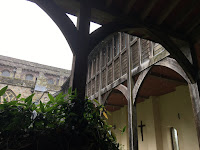
(c) Tony Gillam 2020

Finally I was allowed into the refectory but had to wait five minutes more while the coffee machine heated up. In the fullness of time, I was rewarded with an excellent Americano. In the cosy cafe, I drank my coffee and pulled from my backpack a copy of New Humanist magazine that I'd brought with me. I'm not a humanist - at least, I don't think of myself as one, but perhaps I am. I'd bought this magazine simply because it had some interesting articles in it - a feature on the myth of the self, and a quirky piece about how Turkey passed a law in 1925 banning the wearing of the fez. There were a couple of items about blasphemy. While I'd been in lockdown and in full-time carer mode, back in April, it seems a prominent Nigerian humanist called Mubarak Bala had been arrested on charges of blasphemy. In the same month, I read, blasphemy had been decriminalised in Scotland. Apparently, Northern Ireland still has an active blasphemy law whereas the Republic of Ireland decriminalised it in 2018, and England and Wales in 2008. Lucky for me that blasphemy was no longer illegal in Wales, I reflected, as I flicked through my copy of New Humanist in the refectory of this centuries old seat of Christianity where, for the past 1,500 years, prayer and worship have taken place. At least I wasn't wearing a fez.

Friday, 4 September 2020

Time for some proper musical refreshment

Watching live music is a little tricky at the moment so it's an excellent time to catch up on some CD releases. Here are three recent albums that should help to keep our spirits up.  The smell of rain, an isle in the water ...and tea and symphony. Just what we need to provide some proper musical refreshment...


Can You Smell the Rain 

Nils Kercher 

(Ancient Pulse Records)

Can You Smell the Rain sees world music multi-instrumentalist Nils Kercher heading off in a new direction. The Bonn-based musician's earlier albums Ancient Intimations and Suku - Your Life Is Your Poem conjured up dreamy, mesmerising soundscapes featuring kora and West African percussion, but Nils has gone back to the guitar as a main instrument on his latest album. In doing so, the tracks on 'Can You Smell the Rain' are much more in a singer-songwriter vein than his previous albums, though the kora is never far away and a rich melange of percussion is also on display.

Some have compared Nils' sound to Paul Simon's Graceland but I was reminded much more of very early Simon and Garfunkel records, with the gentle voice and filigree acoustic guitar on tracks like 'Feathers'. I also detected shades of Jon Anderson and Yes, both because of the singing and the ever-evolving nature of compositions like the title track - a funky shapeshifter of a song.

As with his earlier albums, there is something delightfully original and refreshing about Nils' music. Guitars, percussion, kora, violin, piano and vocals all blend together to create an effect like a welcome rainstorm on a hot day.


To an Isle in the Water 

Brisk 

(Appel Rekords)

If Nils Kercher's music is not bound to any particular region, Brisk's music sounds thoroughly and authentically Irish, so it comes as a big surprise to discover the quartet are actually Belgian! Their fiddle player, Naomi Vercauteren, graduated from Ghent Conservatory having completed her thesis on bowing styles in Irish folk music.  And why are they called Brisk? Their publicity material helpfully explains their music is lively and quick ...and "just sounds brisk!"

This debut album is a carefully-curated collection of elegant and energetic versions of Irish, Scottish and Breton tunes featuring, alongside Naomi's fiddle, Gunnar Van Hove's Irish flute and whistles, Jeroen Knapen's guitar and vocals and Wim Moons's bodhrán, vocals and mandolin.

Most of the tracks are medleys comprised of tunes boasting quirky titles. 'Sofie's', for example, combines 'Sofie's Doopwals' with Hamish Napier's 'Grant Wood Reversed Into My Dad's Fence'. Contrasting with the ...well, yes, briskness of the instrumental tracks is a touchingly delicate rendition of the sea shanty 'Leave Her, Johnny', while Jeroen and Naomi's 'Shy One' is an impressive setting of W.B. Yeat's poem 'To an Isle in the Water', which also provides this admirable album's title. 


Tea & Symphony 

- the English Baroque Sound 1968-1974 

(Ace Records)

Musician and music journalist Bob Stanley has put together this affectionate compilation of tracks from that magical period in English pop music, the late sixties and early seventies. As the sleeve notes eloquently put it, "the English Baroque sound shunned guitar solos for string quartets and woodwind. Drenched in summer-into-autumn melancholy and never far away from the charts ... it was informed by Paul McCartney's 'Eleanor Rigby'  and 'For No One', the Zombies' Odyssey and Oracle and the chamber pop of the Bee Gees and Scott Walker."

The epitome of this style is Honeybus's 'I Can't Let Maggie Go', and this is included along with Colin Blunstone's 'Say You Don't Mind' and Clifford T Ward's 'Coathanger'. Among the previously undiscovered delights for me were Bombadil's 'When the City Sleeps' and Vigrass & Osborne's original version of 'Forever Autumn'.  

Much as I enjoy coming across new music and, indeed, some of the other benefits of the 21st century, I can quite happily reside fairly indefinitely between 1968 and 1974, so Tea & Symphony suits me just fine.


Friday, 7 August 2020

Travelling on

I started the 'Passengers in Time' blog at the end of 2010. I'm not the most prolific blogger but I suppose I've averaged about ten posts a year here on this blog. I've covered a variety of topics from books that I'd been reading to books that I'd been writing, and from music I'd been listening to, to occasionally music I'd been making. Alongside these adventures with books and music has been a third thread - 'time travel', by which I suppose I've meant a blend of reminiscences, social history and real-life travel. My posts have often been written in a voice that suggested these were accounts of solitary adventures but, in reality, whether it was walking in Shropshire, drinking coffee in Chepstow, Chipping Norton or Keswick, wandering round lavender fields in Yorkshire, exploring disused railways lines on Dartmoor or ruined castles in Northumberland, staying in windmills in Sussex, appreciating Japanese art at Hanbury Hall, cycling in Kent, picnicking in Paris, visiting chilli farms and Sherman tanks in Devon or enjoying medieval festivals in Tewkesbury, through all of these experiences I'd been accompanied by my dear travelling companion - my beloved wife Sue.    

Reviewing the blog's activity over the years, it's noticeable that my blog posts became less frequent in the second half of 2018. This coincided with Sue being diagnosed with a brain tumour. Through much of 2019, Sue enjoyed reasonably good health and I continued to blog fairly regularly, chronicling some of our trips - to the Ashmolean Museum in Oxford, to Portsmouth to view the recovered 16th-century ship the Mary Rose (which Sue had always wanted to see), to a very unusual concert by Sue's favourite pagan speed folk band PerKelt as well as the last concert we attended together - a China Crisis gig, and an account of our very last holiday together in Devon.  

At the beginning of this year Sue's health deteriorated so that, by the time the coronavirus pandemic had forced everyone into lock-down, Sue and I had already stopped going out and about. Sue was too poorly to go anywhere and I had become a full-time carer. And then, on 25 June, Sue passed away. 

The things that normally console, comfort, energise and enthuse me: reading, listening to music, writing, songwriting, all feel like an effort at the moment, but I know they still hold the power to sustain and renew me. This blog has become an archive - of the books and music I've enjoyed, of the places we've been and the things we've done; it felt wrong to go on writing 'Passengers in Time' blog posts as if nothing had happened, without acknowledging the loss of Sue. I'm going to try to keep on blogging and to go on documenting my adventures with books, music ...and, of course, time travel. 

Sue was always very proud of my writing and I'm sure she would have wanted me to continue, but things are bound to be rather different, now that I've lost my travelling companion.

In memory of Sue Gillam (1965-2020).

About me

My photo
Tony Gillam is a writer, musician and blogger based in Worcestershire, UK. For many years he worked in mental health and has published over 100 articles and two non-fiction books. Tony now writes on topics ranging from children's literature to world music and is a regular contributor to Songlines magazine.